Five database engines. One less window to alt-tab to.
Postgres, MySQL, SQLite, MongoDB and Redis ship inside the Muster binary — no client tools to install, nothing required on PATH. The database work lives in the same window as the code and the agents that depend on it.
Everything in the binary
Each engine gets the full studio: a schema tree, the query editor, a results grid, and CSV/JSON import and export. Your saved connections are project resources, reusable across tasks — and reachable by your agents through Muster’s MCP server, read-only until you grant DB write.
Connections to remote databases ride the SSH tunnels from the host they’re attached to, so a database behind a bastion is a first-class citizen, not a port-forward you maintain by hand.
See the schema, read the plan
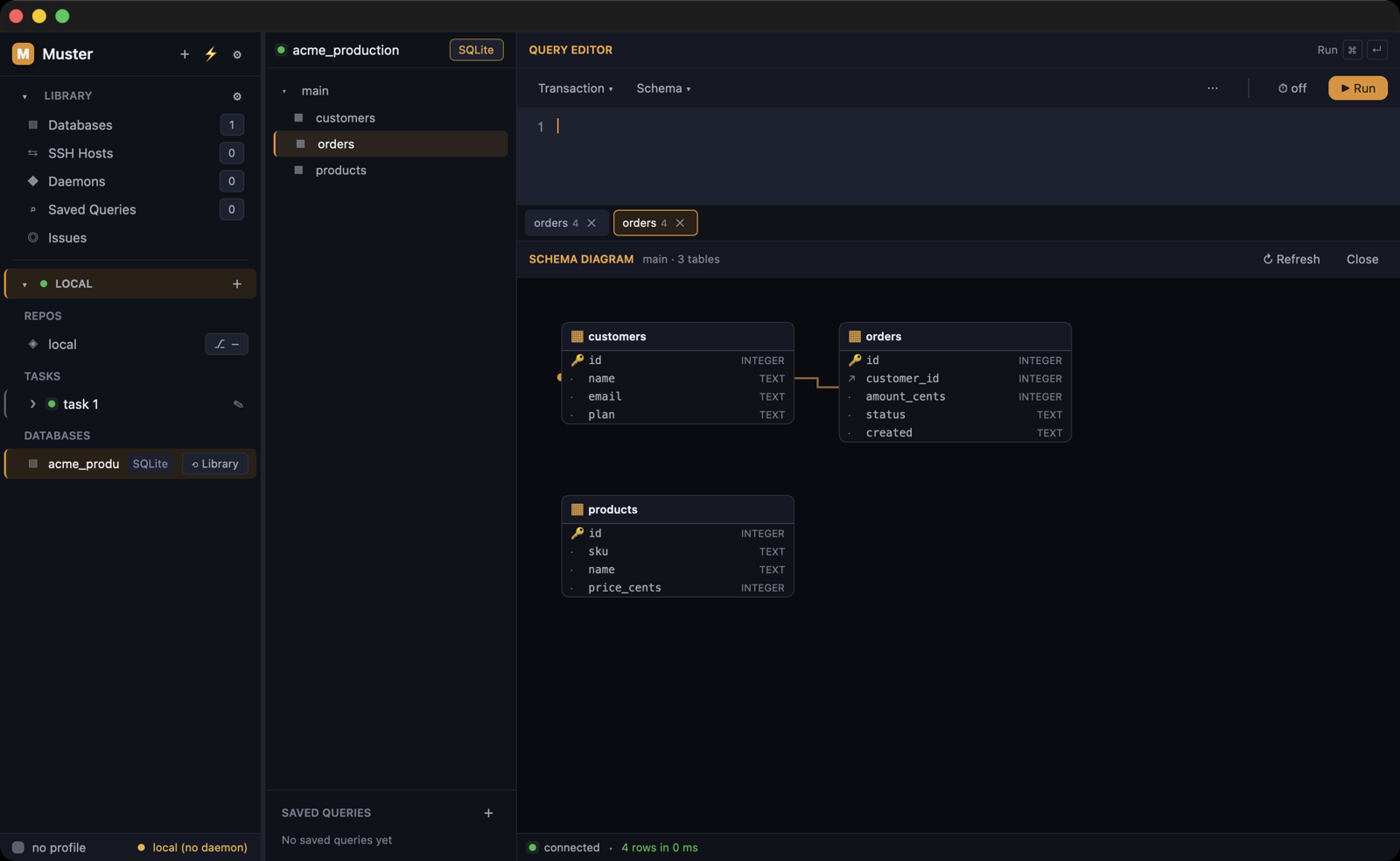
The ERD is generated from your real foreign keys, so the shape you see is the shape the database enforces. The diagram itself is inert — rendered and rebuildable, not clickable navigation. FK-following lives where the rows are: in the results grid, a foreign-key cell jumps to the referenced row.
The EXPLAIN plan visualizer turns a query plan into a node tree you can actually read, instead of a wall of indented text.
Edit rows like you mean it
Row editing is type-aware and bounded to a single row — keyed on the primary key, or the physical row id when there isn’t one. On MongoDB and Redis the results grid stays read-only and edits go through the console instead — the grid says so rather than pretending. DDL and transactions are first-class on the SQL engines, and the SQL editor carries autocomplete, history, saved queries, cancel and per-query timeouts (cancel and timeouts rely on driver cancellation, so they apply to Postgres, MySQL and SQLite).
Backup and restore with a safety net
Backups and restores are native per engine — no pg_dump, no mongorestore, nothing to install. On the SQL engines, restores run transactionally, are safe to re-run, and refuse a truncated or wrong file before touching the database. MongoDB and Redis restores are an archive-restore and a RESTORE…REPLACE respectively — they bring the data back, but they are not transactional.
TLS that actually verifies
Postgres connections support the full sslmode ladder, up to verify-full — and every encrypted mode verifies the server certificate. Client-certificate (mTLS) auth is supported, with the certificate and key required as a pair.
See it on your own repo.
$39 once, per device. A perpetual license, no subscription, nothing that renews. Your code, data and credentials never touch our servers.
Rather try it first? Start the 7-day trial — card up front, $0 charged today, and cancelling before day 7 means you pay nothing. The key appears on screen, ready to paste into Muster.